Culture & Business Transformation
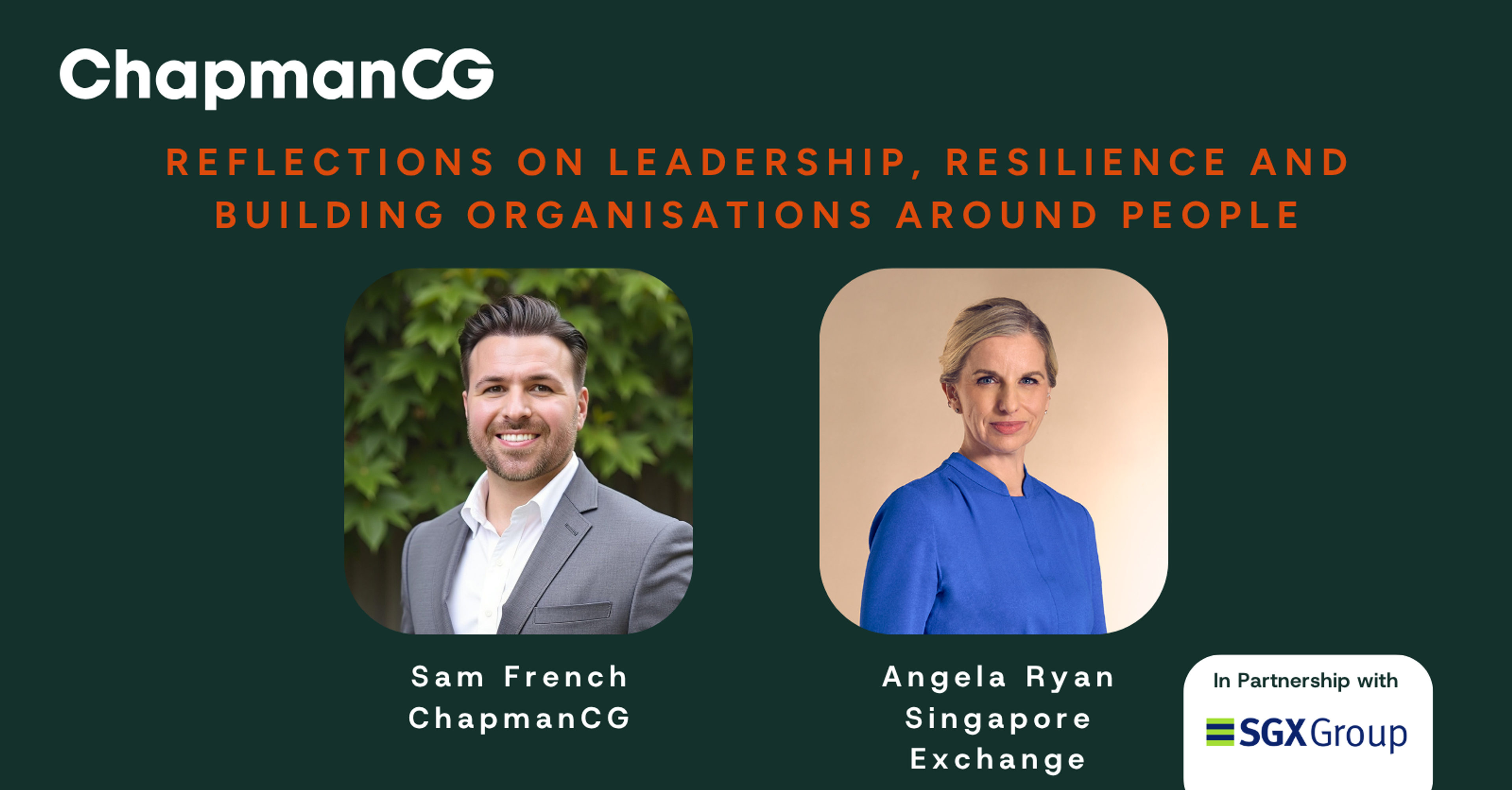
Reflections on Leadership, Resilience and Building Organisations Around People
A Conversation with Angela Ryan
- Date:
- 30 July 2026
Senior leadership careers rarely follow a straight line. They are shaped by moments of pressure, misalignment, learning and, occasionally, crisis. For Angela Ryan, Chief Human Resources Officer for Singapore Exchange, those moments have played out across industries that appear very different on the surface: creative agencies, global entertainment, healthcare during a pandemic, and now financial market infrastructure.
What connects them is not sector expertise, but context. Angela has consistently worked in environments where people operate under sustained pressure and where organisational resilience depends as much on human judgement and wellbeing as it does on systems or strategy.
In this conversation, Angela reflects on the experiences that shaped how she thinks about leadership, why many change efforts struggle to land, and what she believes leaders need to focus on as expectations of senior roles continue to evolve.
A Career Shaped By Discomfort, Not Design
Angela began her professional life training in law and languages, spending time studying and interning in Spain. It was there that she first encountered a feeling that would quietly shape much of her career: being an outlier.
Working as a young British woman in a traditional Spanish law firm exposed her early to hierarchy, power and cultural norms. The work itself did not resonate, but the environment did. She became less interested in the law and more curious about how people operated within rigid systems, how authority was exercised, and how individuals navigated pressure.
Choosing not to qualify as a lawyer felt, at the time, like stepping away from a clear path. HR was not an obvious alternative. Her exposure to the profession had been shaped by a very traditional model of personnel, transactional and disciplinary in nature. It held little appeal.
What ultimately drew her towards HR was not the function, but the questions it allowed her to explore.
Learning At Speed and Leading Early
Advertising and media became Angela’s formative environment. These were places where performance was visible, pace was relentless and credibility had to be earned quickly.
Responsibility came early. By her late twenties, she was HR Director of one of London’s largest media agencies. Looking back, she is clear-eyed about how much she still had to learn. But that, she says, was precisely the point.
Those environments do not reward waiting until you feel ready. They reward learning in motion. They shape leaders who are comfortable making decisions with incomplete information and taking accountability for outcomes.
That early exposure to responsibility cemented a leadership approach that still defines her today: practical, adaptive and grounded in reality rather and in theory.
Rethinking Change By Starting Somewhere Else
As Angela moved into more senior and global roles, a frustration began to surface.
We’re taught to start with frameworks, change models and communications, and then we’re surprised when change doesn’t stick.
Despite the sophistication of organisational change models, she saw the same pattern repeat itself. Carefully designed programmes that failed to land. Well-communicated strategies that never fully embedded.
Her conclusion was both simple and challenging: change was being approached from the wrong starting point.
Rather than beginning with frameworks and communications, she believed organisations needed to begin with the individual. How people experience change emotionally, physically and cognitively. How prepared they are to absorb it. How supported they feel while navigating it.
This thinking led her into doctoral research, undertaken alongside senior roles. It was not an academic exercise for its own sake. It was an attempt to build something usable, grounded in lived organisational reality rather than abstract theory.
When Theory Meets Reality: Healthcare During COVID
That thinking was tested in the most demanding conditions imaginable when Angela moved into healthcare shortly before the COVID-19 pandemic.
The shift was abrupt. One moment she was working in global entertainment, the next she was trying to understand a virus no one fully understood.
The day I found out a colleague had died after contracting COVID while treating patients was the only time I’ve ever cried at work.
The moment that crystallised everything and brought a sharp clarity to her role and priorities.
At that point, many traditional HR processes simply fell away. Performance evaluations stopped. Standard routines were stripped back. What remained was a singular focus on people.
How do we keep people well?
How do we support them physically, mentally and emotionally?
How do we protect families if the worst happens?
Because Angela had already been developing a human-centred framework, her teams were able to move quickly. Drawing on medical expertise within the organisation, they worked with specialists in sleep science, nutrition, cognitive behavioural therapy and physical health. The aim was not to offer generic well-being initiatives, but to design work and support around how people actually function under sustained pressure.
The experience reinforced a core belief that has stayed with her since:
It showed me that you can do the hardest things in the hardest moments if people trust that you genuinely have their interests at heart.
Translating Resilience Into Financial Markets
Today, as Chief Human Resources Officer at Singapore Exchange, Angela operates in a very different environment. But the underlying principles remain intact.
An exchange, she explains, is fundamentally a technology platform. Its DNA is resilience. But that resilience cannot be achieved through systems alone.
Human judgement, decision-making, innovation and sustained performance sit at the heart of stability. Without resilient people, there is no resilient platform.
Rather than importing healthcare practices wholesale, Angela focuses on translating principles. Start with the human being. Design work around how people perform best. Integrate technology and new tools as part of capability, not necessarily as a replacement for it.
What the CHRO role really demands now
When Angela reflects on the evolution of the CHRO role, she is clear that its core purpose has not changed.
The job is to deliver capability.
That capability increasingly spans people, technology and systems. AI, data and digital infrastructure now sit alongside traditional people agendas. What has changed is not the intent of the role, but the breadth of the toolkit required to fulfil it.
What also feels different now is the ability to evidence impact.
What used to be labelled fluffy is now measurable. We can show what works.
Areas once dismissed as intangible can now be measured, analysed and linked directly to performance and outcomes.
Leading Across Cultures Without Losing Yourself
Having worked across regions for much of her career, Angela is pragmatic about cultural adaptation. Leadership, she believes, requires flexibility without dilution.
You have to be chameleon-like. Not changing who you are, but understanding how you need to show up in different environments.
Being effective globally means understanding hierarchy, communication norms and behavioural expectations, and adjusting how you show up accordingly. Early missteps taught her quickly that cultural intelligence is not optional in senior roles.
At the same time, values remain non-negotiable. Adaptation is about behaviour, not identity.
Advice Grounded In Experience
For HR leaders coming through, Angela consistently returns to mindset over mechanics.
Be very clear about what you believe. What you believe shapes the experience people have at work. Our profession changes fast. If you’re not actively keeping your skills relevant, they will become obsolete.
Her most enduring lesson is one she wishes she had learned earlier.
Take the job seriously, but don’t take yourself too seriously. Make the work about the work, not about personal recognition.
It is a perspective forged not through titles or tenure, but through experience at moments when leadership mattered most.