Culture & Business Transformation
People & Culture as a Scaling Engine
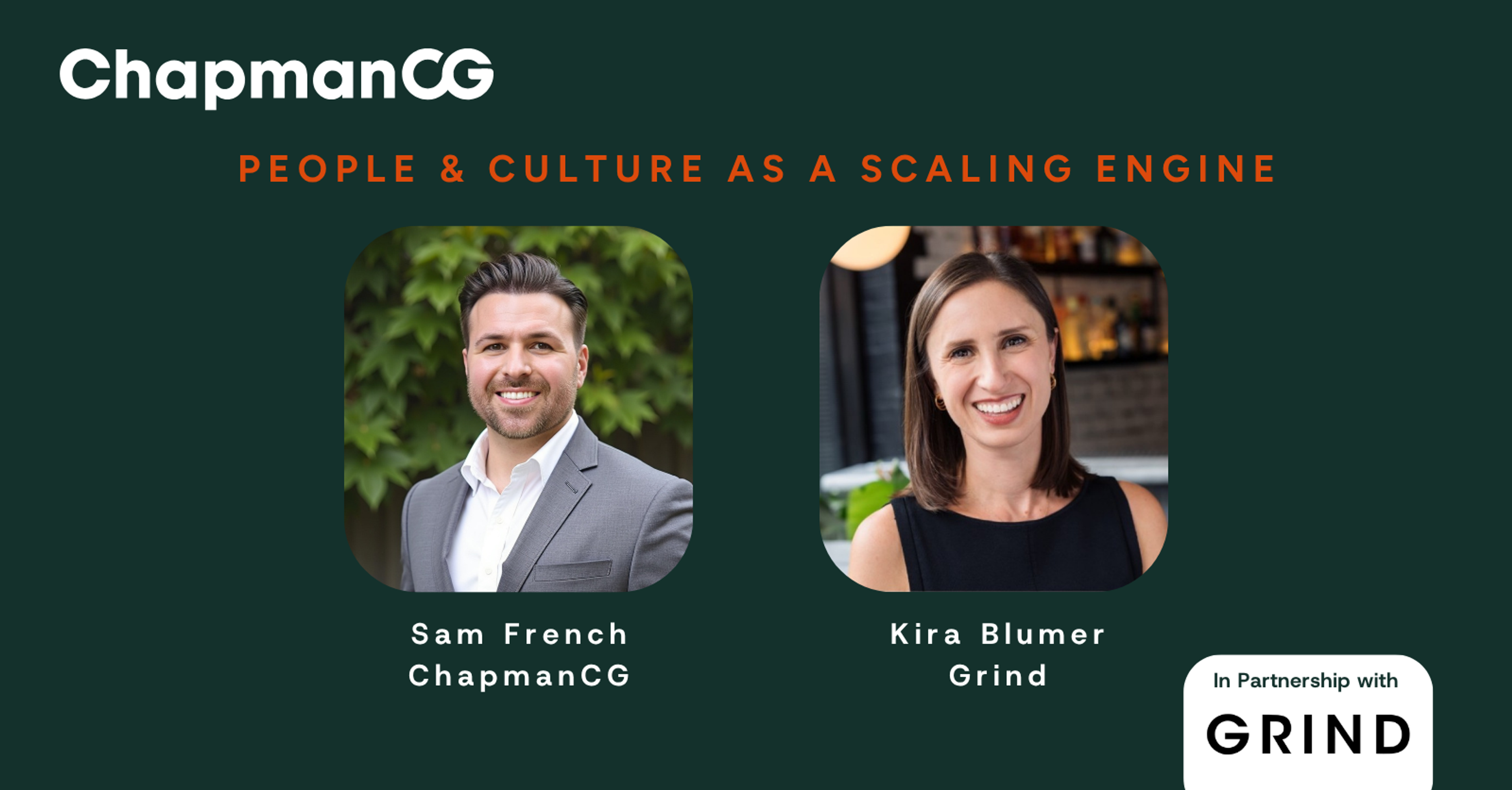
A Conversation with Kira Blumer, Grind
- Date:
- 29 April 2026
There comes a point in every growing business where what got you here is no longer enough to reach the next stage. Not because anything is broken, but because growth introduces new complexity and a demand for greater clarity.
Kira Blumer is Director of People and Culture at Grind, where she is responsible for shaping the culture and people strategy of this fast-scaling consumer business. Her work centres on how the organisation can grow without losing clarity of identity, ensuring that pace, performance and employee experience remain aligned as the business evolves.
Over the past few years, Grind has developed from a well-established hospitality business into an omni-channel brand spanning high street, manufacturing, and FMCG, and the People function has had to develop alongside it.
ChapmanCG Director Sam French sat down with Kira Blumer to learn how she has had to shape and re-shape the People & Culture function as the organisation has grown.
From Sprinting to Doing the Deeper Work
You’ve talked about Grind being in a different phase of growth right now. What does that mean for the People function?
In the last 18 months, we were focused on building capability at pace, both for the People Team and broader business. We focused on bringing in specialist talent, strengthening our teams, and making sure we had the right people in place for the next phase of growth. But that phase only lasts so long. We’ve now got really talented people in place, so the focus has shifted. We’re not sprinting in the same way anymore. We’re doing the deeper work — creating greater clarity across a growing organisation, putting the right structures in place without losing agility, and taking what has always made Grind special and making it scalable.
Translating Vision Into Something the Whole Organisation Can Deliver
How do you partner with the founder and leadership team to translate strategy into something that works for the people?
Our founder, David, has always had a very clear sense of where the business is going. My role is helping translate that into something the whole organisation can rally behind and deliver. How do you take a 350-person business from hospitality into FMCG, changing back into startup mode, and bring everyone along for the ride? That’s meant introducing Objectives and Key Results to create alignment, refining quarterly business reviews so everyone understands the strategy, and embedding values into how we measure performance. Making ambition and culture reinforce each other rather than pulling in different directions.
Culture at Scale Has to be Intentional
Grind feels like a brand that would be heavy on culture. How did the values come about?
Grind has always had a strong culture, shaped by the founder, the leadership team and the people who joined early on. But as the business grows and more people join, you have to become more deliberate about protecting and scaling what makes that culture special. It wasn’t that we didn’t know who we were. Agreeing on how to talk about it, that was the hard part.
The result was five values that feel distinctly Grind:
- Challengers
- Purposeful
- Relentless
- Collaborators
- Grounded
They’re now embedded into recruitment and performance, not as a tick-box, but as a genuine lens for what great looks like at Grind.
The Shift the People Function Has to Make
How has the HR function itself evolved as the business has scaled?
Historically, the function was focused on supporting a fast-moving hospitality business, and rightly so. As Grind expanded into a broader omni-channel brand, the remit naturally evolved to include more strategic partnership, planning and organisational design. We centralised people operations, payroll, compliance, contracts, so our People and Culture Business Partners could focus on what the business actually needs from them: sitting shoulder to shoulder with leadership, talking about strategy, structure and how we get from A to Z.
Balancing Strategy and Reality
In a business growing this fast, how far ahead can you realistically plan?
I used to plan on two-year horizons. In an agile business like this, plans become outdated too quickly. I’ve learned that you have to run two tracks simultaneously, a longer-term view of the capabilities, leadership behaviours and culture you’re building towards, and a much shorter-term focus on the operational fundamentals that let everything else function. Getting the calibration right between those two is really hard, and I haven’t always gotten it right. But we’re in a good place with it now, with the full expectation that in six months, it will need to shift again.
What Leadership Needs to Look Like Next
What does leadership need to look like as Grind moves into its next chapter?
Our leaders are both strategists and operators, by design and by necessity. We value that. It keeps leadership grounded. But what got you here won’t get you there, and that applies to leadership models as much as anything else. We’re at an exciting point where we can start to define what leadership should look like for the next chapter of Grind.
At its best, HR is not there to slow growth down or add unnecessary processes. It exists to help ambitious businesses keep growing in the right way, protecting what makes them special while building the structure and clarity needed for what comes next. The result is not a different business. It is a stronger, more scalable version of the same one.